
At Fort Myers Concrete Experts, we grind, densify and hone interior slabs into a smooth, hard floor that stops dusting and doesn't soak up spills. The first visit also settles whether your floor is a good candidate at all.
Is my bare interior slab ready for polishing?
Yes, if the slab is sound and the problem is the surface. Raw, unsealed concrete sheds dust under foot traffic, and oil, water and household liquids soak into the open pores and stain.
Polishing suits a sound interior slab, such as a home addition or a shop floor, where you want a finished floor without laying tile or carpet over it.
It won't fix a slab that's structurally failing. If yours is shattered, sunken unevenly, or crumbling into loose chunks, grinding won't make it flat, and you need repair or replacement before anything gets polished. We'll tell you that at the inspection rather than polish over a problem.
See also concrete repair and restoration. Ready to hire for a concrete contractor in Fort Myers? Start with our home page.
Related reading: What Happens During Concrete Work: The Steps Explained · Comparing Concrete Work Quotes: What Is Worth Checking
What happens between the first grinding pass and the finished floor?
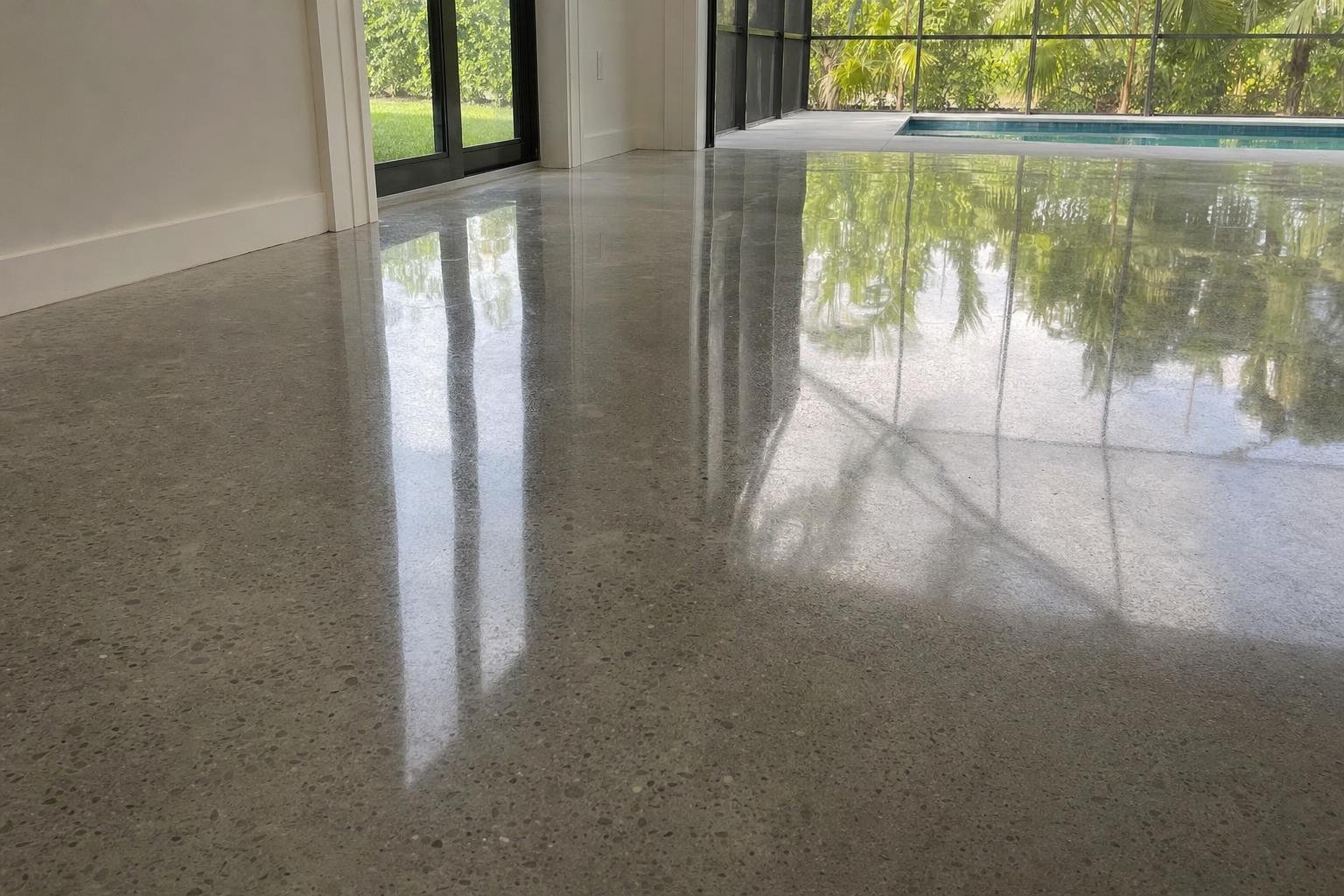
We start with a coarse grinding pass to take off the worn top of the slab and get down to clean, flat concrete. Right after that pass, we apply a silicate hardener/densifier across the floor to harden the surface and cut the dusting.
Next we hone with resin-bond diamond segments, moving up to a finer grit each pass. Each finer pass removes the scratches left by the one before, and the sheen builds up from the concrete itself rather than from a coating.
We fill cracks and joints with an epoxy filler that stays slightly flexible, so they don't show through the finished floor as open gaps. We finish with a stain-guard treatment applied on top, so a spill has that layer to get through before it reaches the concrete.
Does Fort Myers humidity matter for a polished floor?
It does when the slab sits on the ground. Our humidity load stresses buildings, and Lee County has poorly drained sandy ground with a seasonally high water table, so a slab can run damp in the wet months.
Before we seal anything, we check the site conditions around the slab and look for signs of dampness. If a room is holding moisture, we'd rather tell you than seal it in under a stain-guard. A dry slab takes the densifier and the topical treatment the way it should.
What does concrete polishing cost?
Price follows the square footage of the room and the condition of the slab before any grinding starts. Honing and densifying a clean floor is the base job.
If the floor needs extensive surface preparation, say from old glue, paint or heavy pitting, we add about $2 per sq ft on top. We can give you that $2 figure on the call, and it only applies if the slab needs the extra prep.
After we've inspected the slab and measured it, you get a written estimate before any work starts.
What happens when I call?
You call, we ask a few plain questions: roughly how many square feet, how old the slab is, and whether there's carpet glue or an old sealer on it. The call costs nothing.
The hardness of your concrete and the gloss level can wait; neither is a question for the call. Then we book a visit, inspect the slab for cracks and moisture, and write up every step of the job so you can decide in your own time.
You Might Also Need
A Few of the Specifics
In plain terms, some of the details:
- Continue resin-bond polishing passes until the specified gloss level is reached.
- Apply a protective stain guard after polishing if extra protection against grease, oil, or chemical spills is desired.
Straight Answers
Call us with the details you have, and you'll get a straight answer.
Estimates · No-pressure scheduling