
In Fort Myers the cause is usually water in the ground under the slab. Send us the length, the width and what you're seeing.
Why do walkways in Fort Myers sink and hold water?
The ground here drains poorly and the water table sits close to the surface for part of the year. Immokalee sand, which is mapped in Lee County project areas, is poorly drained, and the shallow seasonal water table affects both the digging and the base we build on. The Caloosahatchee watershed adds low elevations, high groundwater and little room in the soil to absorb a heavy rain, so flooding can be very local, sometimes just your side yard. That is why we treat drainage and the finished height of the walkway as part of the job. A walkway poured a little too low becomes the place the water collects.
A common next step is concrete slab and foundation installation. Need a concrete contractor in Fort Myers for another job? Start on our home page.
Before you book: What Concrete Work Costs and What Moves the Price · Warning Signs You Need Concrete Work
What does a standard concrete walkway cost, and what changes the number?
Plan on $7 to $11 per square foot for a walkway or sidewalk with a standard finish. Three things push the price up or down: how much old material has to come out, how much digging the soft or wet ground needs, and how many curves or corners the layout has. A straight run costs less to form than one with curves or a turn at the porch. Tell us the length and width when you call and we'll say which end of the range a job like yours tends toward.
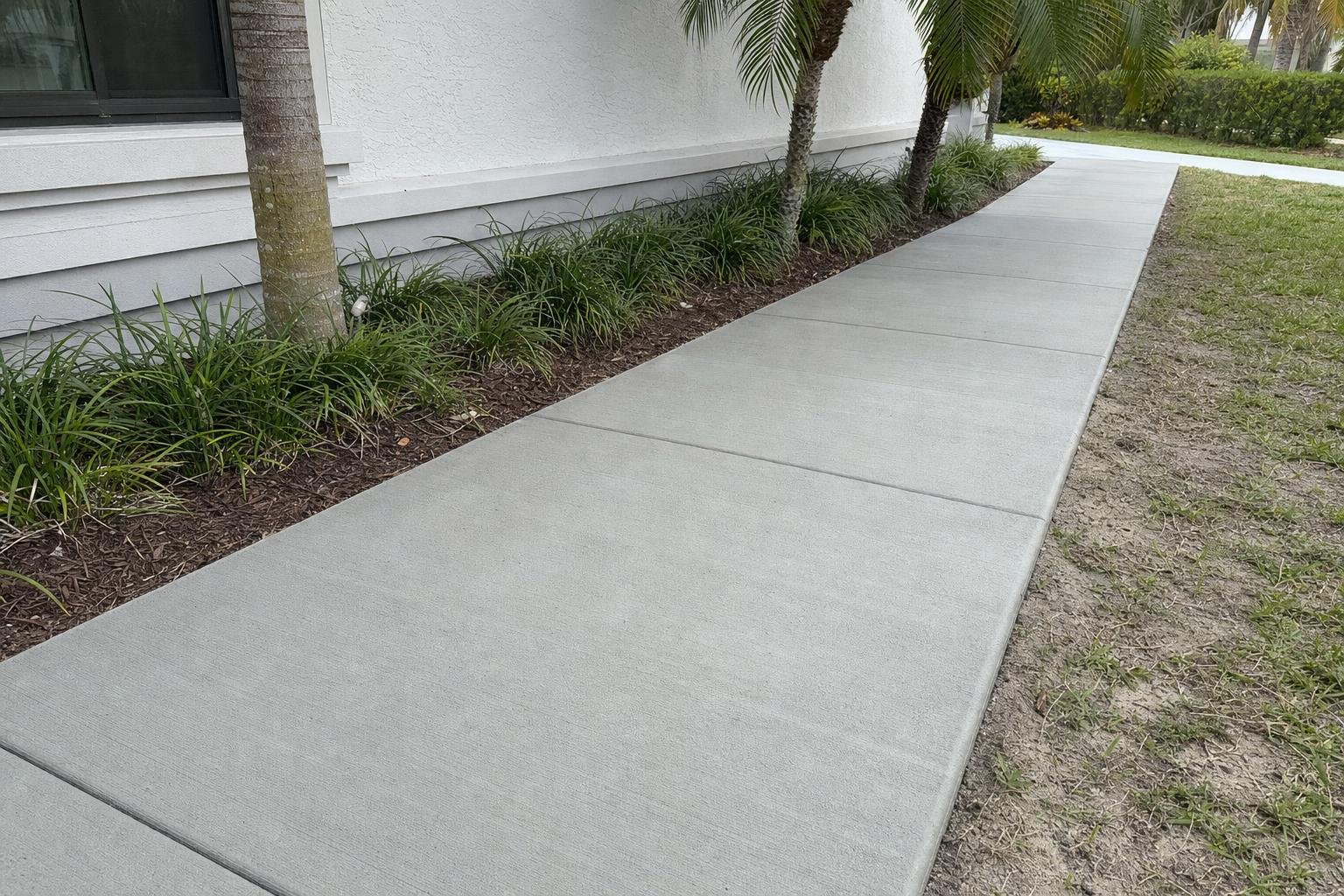
How is the walkway built, step by step?
We start with mason's string and stakes to mark the edges and the width. Where the path borders lawn, a sod cutter and shovel take out the grass cleanly. After the dig-out we set the gravel base and the forms. Before the pour we dampen the gravel, but never to the point of standing water, because wet pockets in the base are what you don't want under fresh concrete. We then place and spread the concrete inside the forms and screed it to the profile we've set. Next comes the float, and last an edger run along the forms for a clean, rounded edge.
Do you actually need a new walkway?
Not always. A single hairline crack in a slab that is still flat and drains toward the lawn can usually be left alone or sealed. Replace the walkway when the cracks run through and the pieces have shifted, when one section has sunk and created a trip edge, or when water stands on it after rain. Standing water usually means the base or the finished elevation is wrong, so a surface patch won't cure it. A new slab with a proper base and fall will.
What's the first step?
Call with the approximate length and width of the walkway and tell us what it's doing, whether that's cracking, sinking or holding water. That call gets you the usual range and asks nothing of you, no commitment and no decisions. Once we've measured and checked how water runs around the area, the quote comes to you in writing.
What It Typically Costs
Most jobs land inside these ranges, and we'll explain what moves a price up or down.
$8.00–$11.50 per square foot
Example: about $800–$1,150 for 100 sq ft
$1,250–$3,050
$7–$11 per square foot
Example: about $725–$1,100 for 100 sq ft
You Might Also Need
Straight Answers
Pick up the phone and run it by us, and you'll get a clear answer.
Estimates · No-pressure scheduling